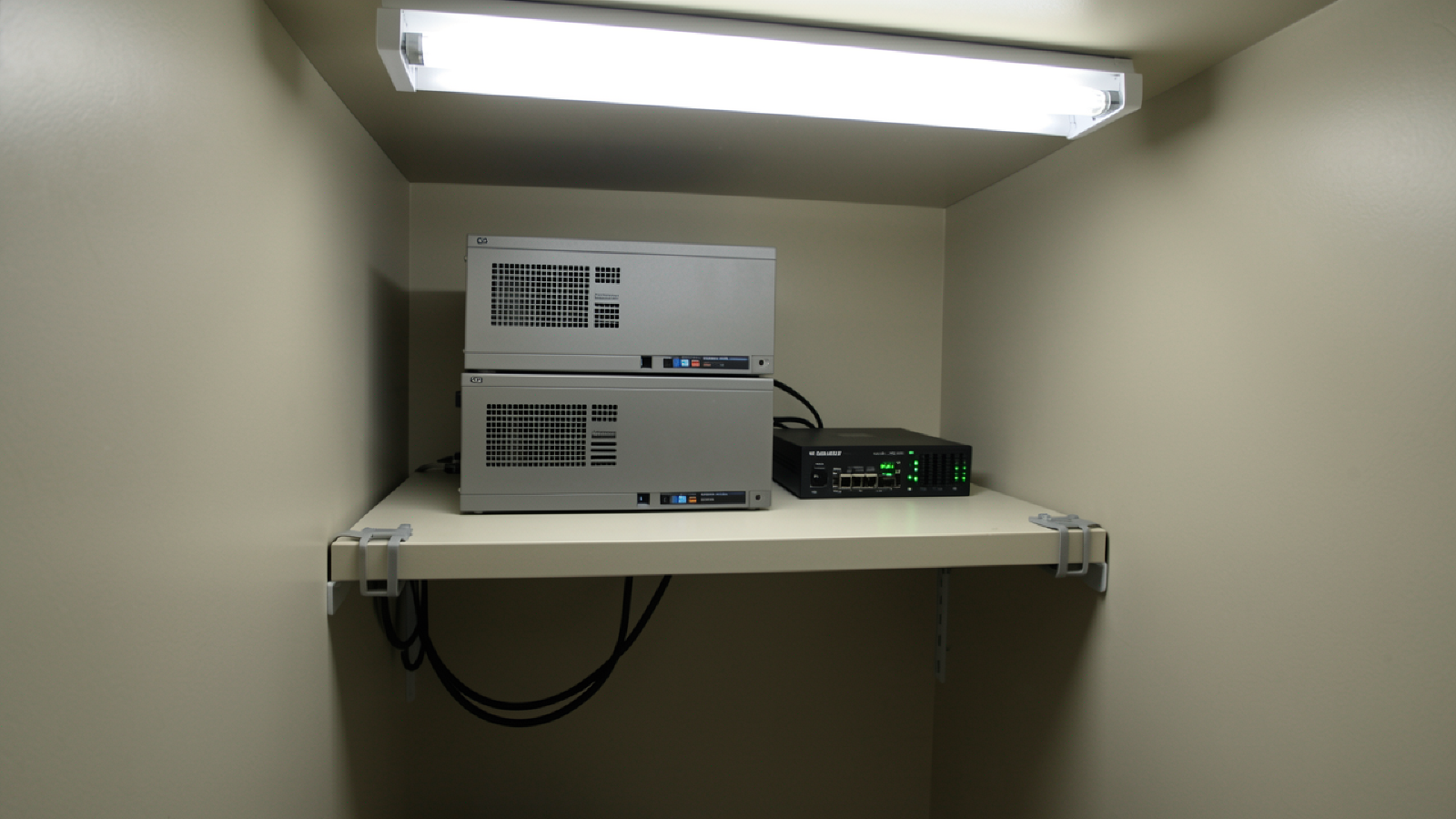
The supply closet at the back of Dr. Chen’s practice used to hold three shelves of paper forms, two broken blood pressure cuffs, and a printer that everyone assumed someone else was responsible for. In January, it held something different: two GB10 compute units stacked on a shelf, one AMD 64GB mini PC beside them, a network switch, a power strip, and the 18 inches of cable management that distinguishes a professional installation from an improvised one. The whole configuration draws about 120 watts, less than a large computer monitor, and occupies roughly 2 square feet of shelf space. The paper forms are in a recycling bin.
That closet now runs the operational intelligence for Dr. Chen’s practice: processing claims, monitoring credentialing expirations, analyzing scheduling patterns, tracking prior authorization submissions. It also runs the privacy-critical inference for approximately 150 BlueMirror consumer subscribers within a 15-mile radius, aging adults whose AI concierge agents handle health coordination, financial monitoring, benefits navigation, and daily support. The same hardware. The same facility. Two value streams from one closet.
This is the Zone 2 tech closet. It is the physical anchor of the BlueMirror ecosystem in each community where it operates.
The Dual-Purpose Economics#
The three-tier compute architecture (described in BMT-09.01) positions Zone 2 as the regional compute layer: more capable than the minimal Local Pane in individual homes, purpose-built for the inference demands of the full concierge agent suite, serving a geographic cluster of subscribers and healthcare entities simultaneously.
For the PE firm, the Zone 2 deployment creates a specific economic geometry. The practice is both a BOI operational intelligence customer and a Zone 2 infrastructure host. It pays a platform fee for operational intelligence. It receives hosting consideration for the compute it houses. The net financial relationship between the fund and BlueMirror is not a pure cost line, it is a partnership with two directions of cash flow.
For BlueMirror, Zone 2 deployment through PE-owned facilities solves a geographic infrastructure problem that pure cloud deployment cannot. A cloud-only compute architecture serves aging adults in dense urban markets where latency and data center proximity are manageable. It serves rural communities poorly, not primarily because of latency (modern cloud architectures handle that adequately) but because of privacy. The consumer subscriber whose health intelligence is processed in a cloud data center 1,200 miles away has a different privacy posture than one whose intelligence runs on hardware 2 miles from her home. Zone 2 at local facilities makes the privacy architecture tractable in every geography where PE healthcare portfolios operate, including rural markets that are underserved by both consumer AI platforms and specialty healthcare.
For the community, the Zone 2 node changes the practical availability of the BlueMirror consumer platform. Consumer subscribers in a rural community without a Zone 2 node would rely on cloud-tier processing for their most sensitive intelligence tasks. Consumer subscribers in that same community after a Zone 2 node deploys at the local PE-owned practice have local compute handling their privacy-critical inference. The geographic expansion of the PE portfolio’s operational footprint becomes the geographic expansion of the consumer platform’s privacy infrastructure.
The Hosting Arrangement#
The economic model for Zone 2 hosting is an open decision, three structures are under consideration, and the right choice depends on fund priorities, portfolio geography, and the relative weighting of predictability versus alignment.
The hosting fee model treats Zone 2 as a real estate and power transaction. BlueMirror pays the PE firm a monthly hosting fee of approximately $500 to $1,500 per node, depending on the facility’s operational costs, local power rates, and the density of consumer subscribers served by that node. The PE firm receives a predictable income stream from a physical asset. The model is simple and auditable, the hosting fee is a line item, not a percentage calculation. The limitation is that it creates no incentive for the PE firm to expand the consumer subscriber base served by the node or to invest in network improvements that would allow the node to serve a larger radius.
The subscription discount model credits the hosting value against the practice’s BOI platform fee. A practice that would otherwise pay $1,200 per month for the operational intelligence platform pays $700 per month as a hosting credit, with $500 implicitly representing the hosting arrangement. The financial simplicity is appealing: no separate payment stream, no separate accounting. The limitation is symmetrical with the hosting fee model, no incentive alignment with consumer subscriber growth.
The revenue share model gives the PE firm a percentage of consumer subscription revenue attributable to subscribers served by the node. At 5 to 10 percent of consumer subscription revenue, a node serving 150 active subscribers at $70 per month (the year 3 to 5 consumer rate) generates $525 to $1,050 per month in revenue share for the fund. The alignment is direct: the PE firm benefits when more subscribers in the area adopt the consumer platform, creating a reason for the fund to advocate for consumer adoption in communities where it already has clinical relationships. The complication is that revenue share requires ongoing tracking and attribution, which subscribers are served by which node, what happens when a subscriber moves or when the node’s service radius changes.
The analysis framework for choosing between the three models is detailed in the private appendix. The directional conclusion: funds that want to actively participate in consumer growth should consider the revenue share model. Funds that prioritize simplicity and predictability should consider the hosting fee. Funds managing finance teams with high overhead sensitivity to new accounting structures should consider the subscription discount.
The Flywheel#
The Zone 2 tech closet connects two ecosystems that reinforce each other at the infrastructure level. Understanding the reinforcement requires following the loop.
BOI deployment at a practice leads to Zone 2 node installation. The installation serves operational intelligence for the practice and neighboring BOI entities. It simultaneously makes the consumer BlueMirror platform viable for a 15-mile radius of aging adults who previously could not access privacy-compliant local compute. Consumer subscribers in the area adopt the platform, each running their 15 concierge agents on local hardware that happens to sit in a supply closet two miles away.
Some of those consumer subscribers use services from PE-owned entities. Margaret’s health concierge coordinates her cardiology follow-up with a PE-owned physician practice. Her NEMT concierge coordinates wheelchair-accessible transport with a PE-owned agency. Her nutrition concierge connects her medically tailored meals to a PE-owned food-is-medicine operation. Each service interaction generates operational intelligence that flows through the membrane, the consumer side and the operational side both learning from the interaction. The membrane passes exactly what is needed and nothing more: appointment requirements, accessibility specifications, dietary restrictions, delivery preferences.
The operational intelligence from service interactions makes the BOI platform more valuable. The food-is-medicine operation that serves 400 consumer subscribers develops dietary preference and clinical outcome data that makes its production planning more accurate and its quality-based reimbursement documentation more compelling. The NEMT operation that serves 300 consumer subscribers develops route optimization intelligence derived from real appointment patterns rather than statistical estimates. The physician practice that serves 250 consumer subscribers has consumer-side health intelligence that, where subscribers have consented to share it, informs care coordination in ways that purely EHR-derived intelligence cannot.
Richer operational intelligence makes BOI more valuable to the PE fund. A more valuable BOI platform earns higher adoption across the fund’s portfolio. More portfolio entities deploy BOI. More Zone 2 nodes install. More consumer subscribers gain local compute access. The loop continues.
The flywheel is not theoretical. Each component has a deployed analog somewhere in the architecture. What the Zone 2 tech closet does is create the physical infrastructure that makes the flywheel operate at the community level rather than only at the platform level. Without local compute, the consumer platform serves subscribers through cloud-tier processing. The Zone 2 node makes local intelligence possible, which makes the consumer experience meaningfully better for privacy and latency, which accelerates adoption, which enriches the data, which strengthens the operational platform. The supply closet is not incidental infrastructure. It is where the two ecosystems physically meet.
Deployment Requirements Per Site Type#
The hardware requirement is consistent across site types: two GB10 compute units (inference), one AMD 64GB mini PC (coordination and lightweight workloads), a managed network switch, and reliable power. The power draw is approximately 120 watts at typical load, equivalent to a high-end workstation. The physical footprint is two square feet on a shelf or rack. Network connection must be at minimum 50Mbps symmetric; most modern clinical facilities exceed this. The installation is a half-day professional engagement, not a facilities project.
A physician practice site needs a secured closet or cabinet, network connection to the facility’s existing clinical network, and a dedicated power circuit. The clinical network must be isolated from the Zone 2 inference function at the network layer, consumer subscriber data cannot transit the practice’s clinical network. This is a standard network segmentation configuration, not a novel requirement.
An imaging center site carries the same requirements with one addition: depending on the imaging-related inference workloads the facility runs for its own BOI operational intelligence, a second AMD mini PC may be warranted to prevent inference queue contention between facility operations and consumer subscriber workloads. The compute configuration is flexible; the hardware cost difference is modest.
A lab site is operationally similar to a physician practice. A home care agency office is operationally identical. A care facility, assisted living, memory care, skilled nursing, has a higher potential consumer subscriber count (if residents adopt the platform) and may warrant a larger Zone 2 configuration to serve the concentrated residential population alongside operational workloads.
The deployment requirements are intentionally modest. A Zone 2 node at a rural physician practice with two power outlets and a closet is technically identical to one at an urban imaging center with a full server room. The geography does not change the hardware. This matters for the PE fund’s geographic diversity: the infrastructure cost of deploying Zone 2 nodes in rural markets is not higher than in urban markets, which means the consumer platform can reach rural communities through PE portfolio geography without premium infrastructure investment.
The Geographic Strategy#
PE healthcare portfolios are concentrated in specific geographies by design. A fund that built a rural primary care rollup across central Appalachia has 40 practices distributed across communities where cloud-only compute infrastructure would struggle to deliver the privacy architecture that aging adult subscribers deserve.
Those 40 practices represent 40 potential Zone 2 nodes. If half of them deploy Zone 2 hardware, the consumer BlueMirror platform can serve aging adults across a geography that most consumer AI companies have not meaningfully reached. Each node serves a radius of subscribers in communities where the PE fund already has clinical relationships, employer relationships, and community presence.
The PE portfolio’s geographic footprint becomes BlueMirror’s infrastructure footprint, and the direction runs both ways. Where BlueMirror needs to expand its consumer platform into a new geographic market, a PE fund relationship with existing facilities in that market provides infrastructure without standalone capital investment in new locations. Where the PE fund wants to offer its portfolio entities operational intelligence, BlueMirror’s consumer presence in the same communities creates subscriber relationships that make the service connection through the membrane more valuable.
This is not a deployment convenience. It is the strategic logic connecting BOI to BMT at the infrastructure level. The tech closet is small. The logic it embodies is not.
Cross-references: BMT-09.01 Three-Tier Compute Architecture BOI-06.01 Portfolio Economics BOI-06.02 The Deployment Playbook BOI-03.01 The Physician Practice Vertical BOI-06.SYN From Product to Infrastructure
Technical Appendix BOI-06.04-A is available to partners and investors at partners.bluemirror.tech.