Elena Marquez sits on the investment committee at a healthcare-focused PE firm that has built positions in four clinical services verticals over the past six years. The firm now operates a dialysis platform, a physical therapy platform, an infusion services platform, and a behavioral health platform, each acquired separately and each managed by its own operating team. Elena is responsible for the next acquisition decision, and the question on the table is whether the firm should build a fifth platform in a new sub-vertical or deepen one of the four it already operates. The diligence binders on her desk show, predictably, that each sub-vertical has its own operational quirks, its own regulatory surface, and its own clinical workflow. What the binders do not show, because no one prepared them this way, is that the four sub-verticals share four operational patterns that matter more than the differences. Once Elena sees the shared patterns, the platform decision becomes architecturally simpler than the binders suggest.
Dialysis, physical therapy, infusion services, and behavioral health each represent an active PE consolidation vertical. Each treats a chronic clinical need rather than an episodic one. Each operates through outpatient facilities rather than hospitals. Each is reimbursed primarily by Medicare, Medicaid, and commercial payers through service-specific fee schedules that depend on documentation and quality reporting. The clinical content of the four verticals is unrecognizably different: a dialysis chair has nothing in common with a behavioral health session. But the operational patterns are recognizably the same: capacity is the revenue lever, authorization gates the cash flow, quality reporting determines reimbursement, and workforce is the largest cost challenge. The same eighteen operational concierge agents activate across all four, with different domain-specific models trained for each.
This is the unified platform thesis stated in its narrowest form. Same agent architecture, same orchestration, same governance, different domain knowledge. The four sub-verticals treated here at pattern depth rather than full standalone depth are the proof that the thesis holds across clinical services that differ as widely as ESRD care and outpatient behavioral health.
Four services, one architecture
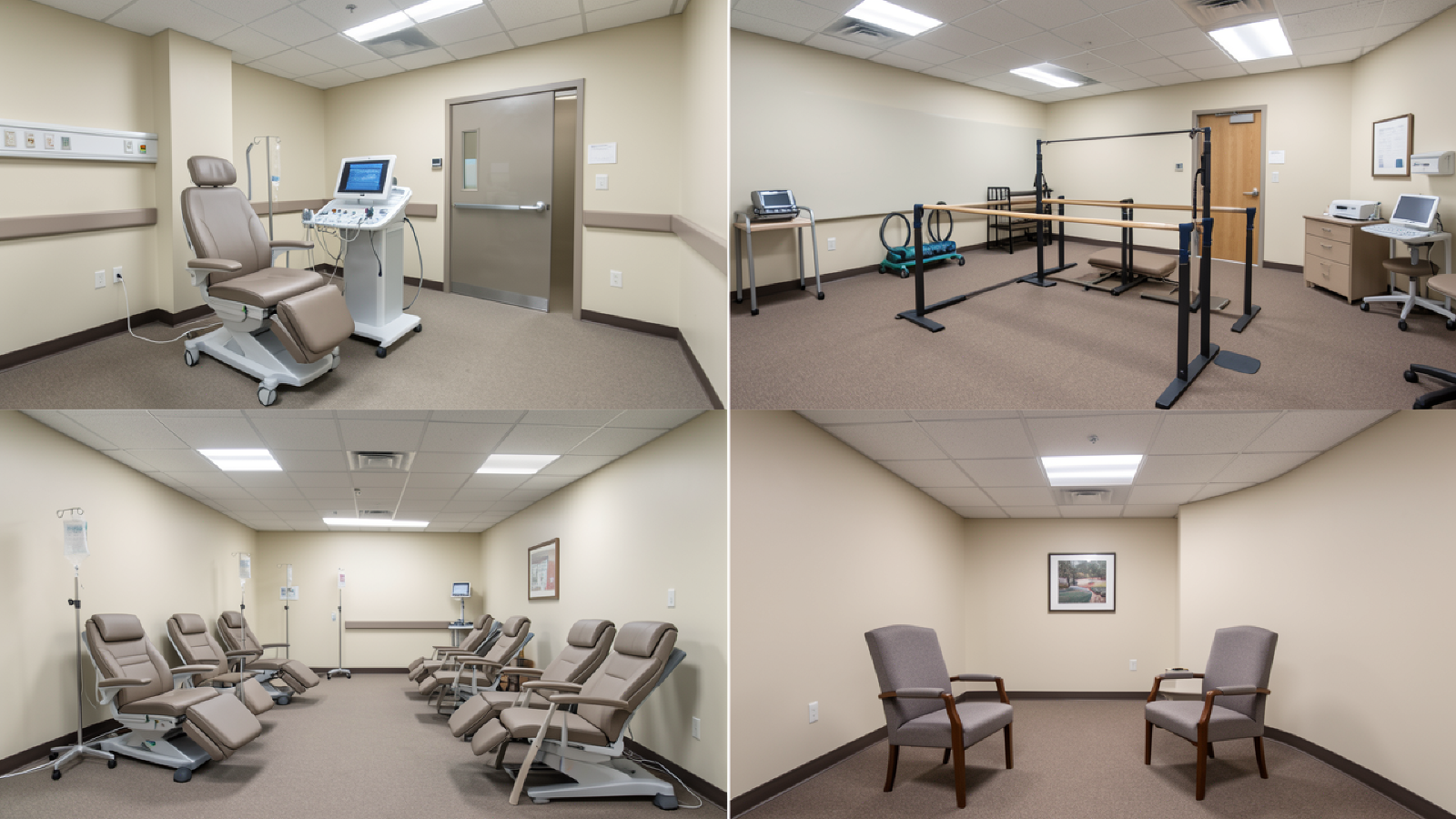
A dialysis chair, a PT treatment room, an infusion suite, and a behavioral health session. Place them side by side. The clinical content has nothing in common. A nephrologist managing fluid balance and ESRD complications shares no clinical territory with a physical therapist running gait retraining, who shares no clinical territory with an infusion nurse monitoring biologic administration, who shares no clinical territory with a clinical social worker conducting trauma-focused therapy. The clinical training, the medical knowledge, the procedural workflow, and the safety considerations are domain-specific in every meaningful way.
The operational architecture is identical in every meaningful way. Each service is delivered through scheduled appointments at a fixed-capacity facility. Each requires authorization from the patient’s payer before the service is delivered or shortly thereafter. Each generates documentation that supports billing and quality reporting. Each carries quality measures that affect reimbursement at the platform level. Each is delivered by clinical staff whose retention determines the platform’s ability to maintain capacity. The pattern repeats across the four because the operational layer of healthcare service delivery, abstracted from the clinical content, is remarkably consistent.
The eighteen operational concierge agents instantiate across all four sub-verticals with the same architecture and different domain-specific models. The scheduling concierge in dialysis manages chair shifts. In PT, it manages treatment slots. In infusion, it manages chair time that varies by infusion duration. In behavioral health, it manages session slots that vary by session type. The agent architecture is constant. The domain model is sub-vertical-specific.
Dialysis
A dialysis chair runs three shifts per day, six days per week, in most facility configurations. Chair occupancy is the primary revenue lever. The scheduling concierge manages patient assignments across chairs and shifts, accounting for patient-specific preferences and clinical requirements, while maximizing effective capacity. A patient assigned to a Monday-Wednesday-Friday morning shift produces predictable revenue. The same patient missing two shifts in a month produces both lost revenue and a quality concern that affects the platform’s ESRD QIP reporting.
Kt/V adequacy monitoring is the principal clinical quality metric, and it ties directly to reimbursement through the ESRD Quality Incentive Program. The quality concierge tracks Kt/V per patient per session and surfaces patterns that predict adequacy failure before the failure manifests as a reportable event. Water treatment compliance, dialysate quality monitoring, and vascular access tracking each carry regulatory documentation requirements that the compliance concierge maintains continuously rather than scrambling to assemble before the next state survey.
Supply chain in dialysis involves dialysate concentrates, bloodlines, dialyzers, needles, and the consumables specific to each manufacturer’s machine. The supply chain concierge tracks inventory per facility per machine type, predicts consumption from patient census and treatment frequency, and identifies redistribution opportunities across facilities in the platform.
The consumer connection runs through the health concierge described in BMT-01.02. For aging adults on dialysis, the schedule coordination with medications, dietary requirements, and transportation arrangements is operationally significant. A dialysis patient who misses transportation to her Wednesday shift misses the shift, which compounds clinically over the week. The consumer concierge handles the transportation coordination through the membrane to the dialysis platform’s scheduling concierge, with the appointment confirmation flowing back to her medication and nutrition concierges to align timing.
Physical therapy
Physical therapy is the sub-vertical where the prior authorization burden is most visible at per-visit granularity. Most commercial payers require authorization for an initial evaluation, then re-authorization at intervals that depend on the diagnosis, the payer, and the documented progress. Medicare’s PT benefit operates under therapy cap and KX modifier provisions that require specific documentation to sustain visit billing above the cap threshold. The prior authorization concierge described in BOI-01.03 carries its most visit-intensive deployment in PT, processing authorizations not at the episode level but at the re-evaluation level across hundreds of active patients per facility.
Therapist productivity and caseload management is the second operational concentration. A PT’s effective caseload depends on documentation efficiency, the specific evaluation and treatment protocols she uses, and the patient mix on a given day. The staffing concierge tracks therapist productivity at the level that the platform can act on without micromanaging clinical work: caseload size, no-show rate per therapist, documentation timeliness, and the patient outcome trajectories per therapist over rolling windows. The information is operationally useful for staffing decisions and clinically useful for the therapists themselves, who often want visibility into their own outcome patterns and rarely have it.
Documentation compliance in PT is among the most prescriptive in healthcare. The therapy notes required to sustain billing have specific elements: functional goals stated in measurable terms, progress against goals documented per visit, plan modifications justified clinically, and re-evaluations conducted at required intervals. The compliance concierge maintains the documentation requirements per payer and surfaces gaps before claims are submitted with deficient documentation. The denial rate for PT claims with documentation gaps runs significantly higher than for claims with complete documentation, and the difference is addressable at the time of documentation rather than at the time of appeal.
The consumer connection for aging adult PT patients runs through coordination with mobility patterns, energy management, and transportation. A patient’s PT progress depends on her ability to complete the recommended exercises between sessions. Her home environment concierge and her mobility-related agents can support the between-session compliance in ways the PT clinic cannot observe directly.
Infusion services
Infusion services occupy chairs for durations ranging from 30 minutes to 8 hours depending on the infusion protocol. Chair scheduling is therefore not slot scheduling but duration-aware scheduling, and the scheduling concierge maintains a model of duration variance per drug per patient profile. A patient on a stable maintenance infusion produces predictable duration. A patient initiating a new biologic produces variable duration, particularly through the first few infusions where infusion reaction monitoring extends the chair time.
Drug inventory is the operationally distinct supply chain in infusion services. The drugs involved are high-value biologics with strict storage requirements, handling protocols, and expiration considerations. A vial of a specialty biologic may cost several thousand dollars and require continuous refrigeration with audited temperature monitoring. The supply chain concierge tracks the inventory at vial-level granularity, monitors storage conditions, predicts consumption from the patient census and authorization schedule, and surfaces redistribution or return opportunities for drugs approaching expiration.
Payer authorization for specialty drugs is the gating workflow for infusion services. Each authorization is drug-specific, indication-specific, and often requires documentation of failed prior therapies, clinical justification specific to the patient, and laboratory parameters within payer-defined ranges. The prior authorization concierge handles the volume that, in a manual workflow, consumes substantial pharmacist and nurse time per infusion center. Clinical monitoring during the infusion itself is a clinical workflow that the operational layer supports through documentation and communication rather than performing.
The consumer connection for infusion patients coordinates medication timing, symptom management, and the transportation arrangements that depend on the infusion duration on a given day. A 6-hour infusion produces different transportation requirements than a 30-minute infusion. The consumer concierge handles the surrounding coordination through the membrane.
Behavioral health
Behavioral health operates differently from the other three sub-verticals in several operationally significant respects. Session scheduling involves multiple session types: 45-minute individual sessions, 60-minute extended sessions, group sessions, and medication management visits, each with different billing codes and documentation requirements. The scheduling concierge maintains the session-type model and the therapist-specific availability across types.
Documentation compliance varies significantly by state and payer. The therapy note requirements differ between the major commercial payers, between Medicare and Medicaid, and between states for the same Medicaid program in some cases. The compliance concierge maintains the documentation requirements per payer per state and surfaces the per-session documentation gaps that would produce denials. The variance is real and operationally consequential: a clinic operating across three states may face three distinct documentation regimes for the same clinical work.
Outcome measurement is the least standardized of any clinical vertical. The PHQ-9, GAD-7, and a small number of other validated instruments are used at varying intervals depending on the clinical context, the payer requirements, and the clinician’s preferences. The quality concierge tracks the measurements that are taken and surfaces the outcome trajectories at the patient level and the clinician level. The information is more useful clinically than the platform sometimes appreciates: a clinician who can see her patients’ aggregate outcome patterns over time can adjust her approach more deliberately than one who cannot.
Cross-provider coordination is operationally significant in behavioral health because patients frequently see multiple providers. A patient may see a therapist for weekly sessions and a psychiatrist for monthly medication management, and the coordination between the two affects clinical outcomes. The operational platform supports the coordination through structured exchange between providers within the platform and through documentation flow for providers outside it.
Workforce in behavioral health presents the highest burnout risk of any clinical vertical. Therapist turnover is operationally consequential because therapeutic relationships do not transfer easily, and a patient whose therapist leaves often does not continue with the platform. The staffing concierge tracks signals that predict burnout risk: caseload patterns, documentation timeliness drift, no-show rate changes, and the soft signals that surface in shift notes. The information is surfaced to clinical leadership for the conversations that the staffing concierge itself cannot have.
The consumer connection for behavioral health patients runs through the cognitive concierge and the caregiver concierge described in BMT-01.07 and BMT-01.08 respectively. For aging adults, behavioral health care often involves cognitive evaluation, family coordination, and integration with primary care that the consumer concierges handle in coordination with the clinical platform.
The pattern that repeats
The four sub-verticals share four operational patterns that, taken together, support the unified platform thesis. Capacity is the revenue lever in every sub-vertical: chair shifts in dialysis, treatment slots in PT, chair-hours in infusion, and session slots in behavioral health. The scheduling concierge handles capacity optimization across all four with the same architecture and different domain models. Authorization is the bottleneck in every sub-vertical: ESRD coverage in dialysis, visit and episode authorization in PT, drug-specific authorization in infusion, and session and medication authorization in behavioral health. The prior authorization concierge handles all four. Quality reporting ties to payment in every sub-vertical: ESRD QIP in dialysis, functional outcomes and KX modifier compliance in PT, drug-specific quality measures in infusion, and outcome instrument tracking in behavioral health. The quality concierge handles all four. Workforce is the largest cost challenge in every sub-vertical, with retention as the operational risk that compounds clinical and financial impact. The staffing concierge handles all four.
The consumer connection improves both operations and clinical outcomes across all four sub-verticals, through the same membrane architecture and the same coordination patterns. The unified platform thesis holds. The four sub-verticals described here at pattern depth are not the only PE consolidation targets the architecture serves. The same patterns apply to urgent care, dental, dermatology, ophthalmology, podiatry, and the other clinical services that PE firms have been consolidating for the past decade. The architecture extends. The operating partner reading this can extrapolate to her own portfolio.
Cross-References#
Scheduling (BOI-01.06). The scheduling concierge architecture, instantiated across four sub-verticals where capacity is the primary revenue lever.
Prior Authorization (BOI-01.03). The authorization architecture, deployed in its most visit-intensive form in PT and its most drug-specific form in infusion services.
Quality and Outcomes (BOI-01.15). The quality concierge that handles sub-vertical-specific quality reporting tied to reimbursement.
Staffing (BOI-01.12). The workforce concierge that addresses the burnout and retention challenges concentrated in behavioral health and high in all four sub-verticals.
The Health Concierge (BMT-01.02). The consumer-side coordination that improves outcomes across all four sub-verticals when the patient is an aging adult engaged with the consumer platform.
Technical Appendix BOI-03.05-A is available to partners and investors at partners.bluemirror.tech.