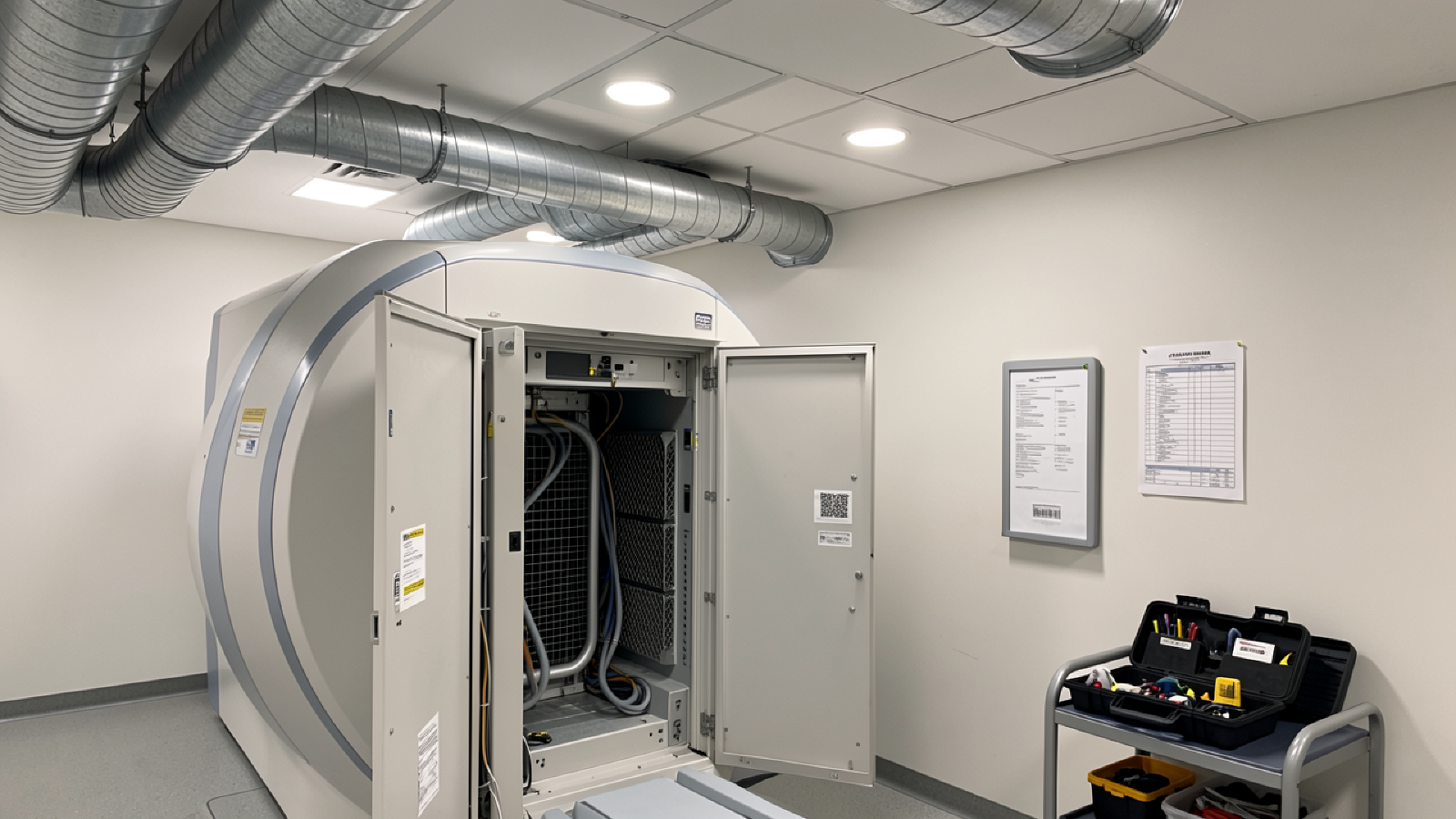
A PE firm acquired an imaging center eighteen months ago. The center has a two-year-old CT scanner running at 38% utilization. The acquisition team evaluated patient volume and revenue. Nobody evaluated equipment fit.
The procurement concierge’s analysis told a different story. The scanner is a high-end cardiac CT, over-specced for this center’s case mix, which is predominantly routine head, chest, and abdominal studies. The lease terms include a technology refresh provision at month thirty-six that nobody in the practice administration knew about. A lower-tier scanner would handle 95% of the center’s case mix at 60% of the current lease cost. Meanwhile, another portfolio imaging center ninety miles away has a CT running at 96% utilization and needs a second scanner for its growing cardiac imaging program. The over-specced unit at the first center would fit the second center’s case mix well.
Two problems visible. One redeployment opportunity. Zero capital expenditure required. The procurement concierge identified this because it sees equipment utilization, case mix, lease terms, and portfolio-wide capacity simultaneously. No individual center manager would have connected these dots because no individual center manager sees the other center’s data.
Capital equipment decisions are among the highest-stakes operational decisions a healthcare entity makes. A $2M MRI purchase locks in a seven- to ten-year commitment. A lease-versus-buy decision on ultrasound equipment affects cash flow for five years. A fleet vehicle purchase for an NEMT company determines operational capacity for 150,000 miles. These decisions are currently made with spreadsheets, vendor sales presentations, and the operating partner’s intuition. The procurement concierge brings data-driven capital asset intelligence to the decision.
Unlike the supply chain concierge (BOI-01.08), which handles continuous consumable optimization at medium autonomy, the procurement concierge operates at the lowest autonomy of any operational agent: 0.25. Strictly advisory. Every capital decision requires human approval. Every analysis is transparent in its assumptions. The agent provides the data and the model. The operating partner decides.
Four functions compose this agent’s work. Equipment lifecycle management tracks every capital asset across the portfolio: age, maintenance history, utilization rate, remaining useful life, technology obsolescence trajectory. Replacement timing optimization calculates total cost of ownership rather than relying on age alone. An MRI scanner that is twelve years old but well-maintained and running at high utilization may have lower total cost of ownership than a five-year-old scanner with a history of breakdowns. The lifecycle model accounts for maintenance cost trends, downtime cost, technology relevance, and residual or trade-in value.
Lease-versus-buy analysis models the financial decision per asset. Cash flow impact over the full term. Tax implications including depreciation schedules and Section 179 deductions where applicable. Technology refresh value, which matters most in imaging where scanner capabilities evolve on three- to five-year cycles. Residual value estimation based on equipment type, age, and market conditions. Maintenance cost inclusion because some leases bundle maintenance while purchases require separate service contracts. The analysis is entity-specific: a practice with strong cash position and growth trajectory faces a different lease-versus-buy calculation than a practice conserving capital for other investments.
Utilization benchmarking compares equipment utilization across the portfolio. The imaging center running a CT at 38% utilization and another running at 96% represents an allocation problem, not a capacity problem. Identifying underutilized assets and capacity-constrained assets is the first step. Recommending redeployment, sharing arrangements, or replacement is the second. The recommendation includes the logistics of redeployment: installation requirements at the receiving site, decommissioning requirements at the originating site, regulatory recertification, and downtime estimates.
Technology assessment evaluates new equipment against current fleet capabilities on a vendor-neutral basis. When a manufacturer releases a new MRI platform, the procurement concierge evaluates it against the portfolio’s existing fleet: what clinical capabilities does it add, which entities would benefit from those capabilities based on their case mix, what is the marginal revenue potential from new study types the current equipment cannot perform, and how does the investment interact with payer contract strategy? A new imaging capability that enables higher-reimbursement procedures changes the revenue model for an entity, which changes the payer contract concierge’s (BOI-01.04) negotiation position.
Portfolio capital allocation is where the procurement concierge serves the PE operating partner most directly. Limited capital across a portfolio of entities, each requesting equipment. Which investments generate the highest return? The procurement concierge models the answer: utilization potential multiplied by revenue per procedure multiplied by strategic value. A $500,000 ultrasound at an entity that will use it at 80% utilization for procedures reimbursed at $400 each generates different returns than the same investment at an entity projecting 40% utilization. Where does equipment redeployment from underperforming entities serve the portfolio better than a new purchase? How does the equipment investment interact with the payer contract strategy?
Fleet management for NEMT applies capital procurement logic to transportation. Vehicle selection decisions between wheelchair-accessible vans, stretcher-capable vehicles, and standard sedans depend on the service area’s client population and their accessibility needs. Fleet size optimization matches vehicle count to route demand with seasonal adjustment. Maintenance cost modeling per vehicle type informs replacement cycle decisions: mileage-based versus age-based versus total-cost-based replacement timing. Electric vehicle transition modeling calculates incentive values, charging infrastructure requirements, route range constraints, and total cost of ownership comparison against internal combustion equivalents.
Facility planning support extends capital analysis beyond equipment. New facility buildout for service line expansion. Renovation for expanded services at existing locations. Accessibility modifications required by ADA compliance or client population needs. The procurement concierge models capital cost against projected revenue, estimates construction timeline against revenue ramp, and coordinates with the compliance concierge (BOI-01.14) on regulatory requirements for new service lines. A physician practice adding an in-office imaging suite requires state Certificate of Need review in some states, radiation safety compliance, and payer credentialing for the new service, each with timeline implications that affect the financial model.
The CT scanner that sat idle at 38% utilization represented a capital allocation failure visible only in hindsight. The procurement concierge makes these failures visible before they compound, identifies redeployment opportunities before they require new capital, and brings data-driven rigor to the capital decisions that determine a portfolio’s long-term asset productivity.
Cross-References#
BOI-01.08 The Supply Chain Concierge. The capital asset versus consumable distinction; procurement handles strategic purchases while supply chain handles continuous replenishment.
BOI-01.06 The Scheduling and Throughput Concierge. Equipment utilization data from the scheduling concierge drives procurement analysis of asset productivity.
BOI-01.10 The Facility and Maintenance Concierge. Equipment maintenance lifecycle data feeds procurement decisions on replacement timing and total cost of ownership.
BOI-01.18 The Portfolio Intelligence Agent. Capital allocation as a portfolio-level strategic function requiring cross-entity visibility into utilization and investment returns.
BOI-06.01 Portfolio Economics. Capital investment ROI modeling within the broader portfolio economics framework.
Technical Appendix BOI-01.09-A is available to partners and investors at partners.bluemirror.tech.