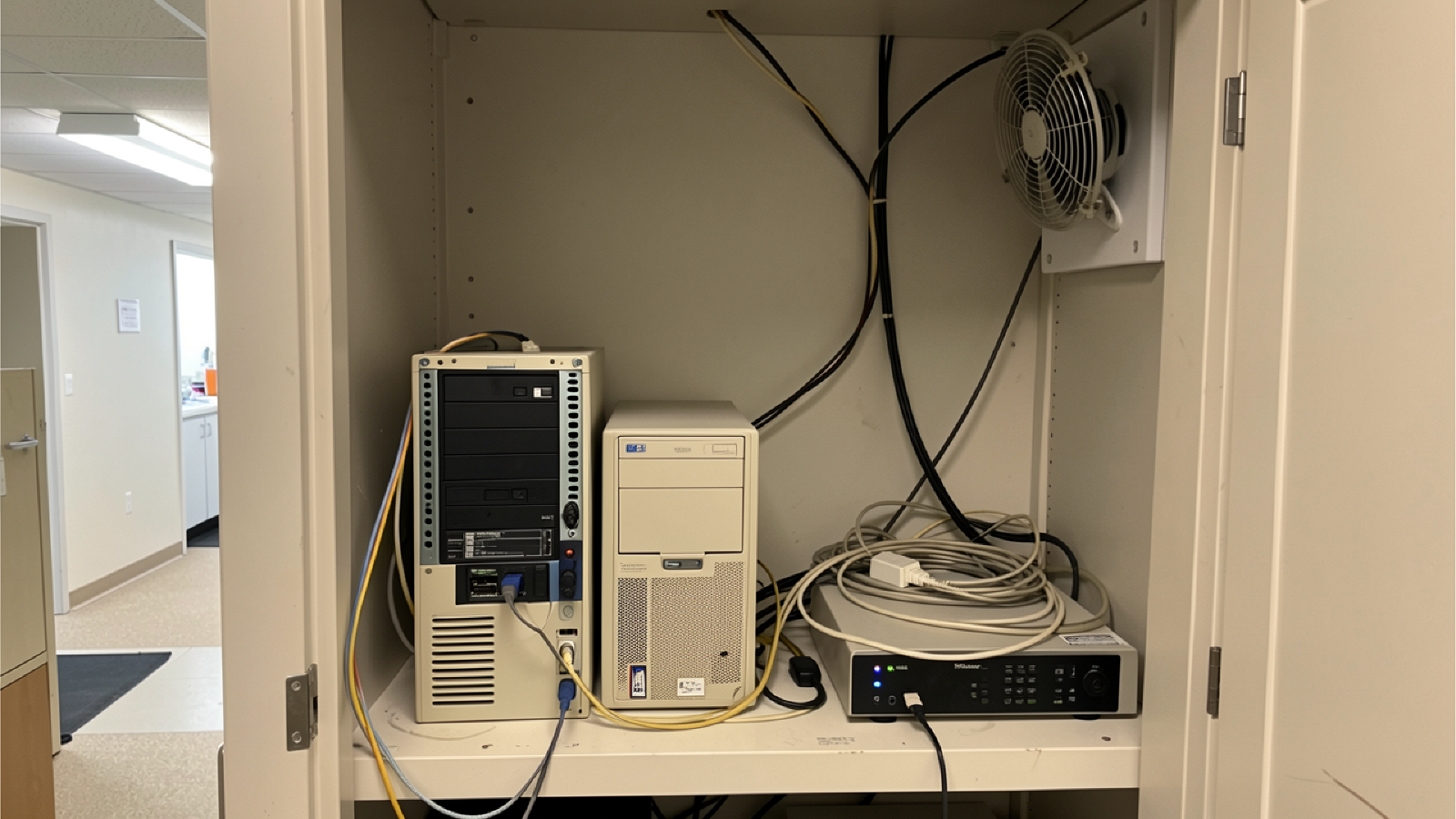
Rachel Sung has lived through three system changes in five years. She is the office manager at a twelve-physician primary care practice in rural eastern Tennessee, and the practice was acquired by a PE firm in 2021. The first change replaced the scheduling system. The second replaced the billing platform. The third attempted to replace the EHR. The third change failed. Two physicians threatened to leave. The front desk staff, who had finally memorized the workarounds for the billing platform’s interface quirks, refused to learn a new clinical documentation workflow on top of everything else. The PE firm’s operations team backed down, and the practice kept eClinicalWorks.
Rachel’s experience is not unusual. It is the median outcome for PE-acquired physician practices attempting system consolidation. The instinct is understandable: standardize the technology stack across the portfolio, centralize reporting, reduce per-entity IT costs. The result is predictable: six months of disruption, physician retention risk, $150,000 in direct costs, and a productivity recovery timeline that stretches past a year. The staff who survived the changes are not more efficient. They are more exhausted.
BlueMirror does not replace eClinicalWorks. It does not replace the billing platform or the scheduling system. It wraps around whatever exists and makes it smarter. Rachel’s practice keeps every system it has. The operational concierge agents connect to those systems through adapters, extract the data they need, deliver intelligence through channels Rachel’s staff already use, and execute actions through the existing interfaces. The staff experience is not “learn a new system.” It is “the system you already know now does things it could not do yesterday.”
This is architecturally necessary, not aspirational. The cost and disruption of replacing a practice’s EHR during PE integration is a primary reason acquisitions underperform their operational thesis. The adapter architecture exists because the alternative, rip-and-replace, has a documented failure rate that no honest operational plan should ignore.
The Adapter Architecture#
Each supported system gets an adapter. The adapter is a translation layer between the system’s native interface and the standardized data model that the operational concierge agents consume. The adapter handles four functions.
Data extraction pulls information from the system through whatever interface the system exposes. For eClinicalWorks, that means a combination of the eCW API, direct database queries where the API is insufficient, and HL7 message parsing for clinical data flows. For Athenahealth, extraction runs primarily through the athenaClinicals API, which is cloud-native and comparatively well-documented. For NextGen, extraction navigates a version-fragmented API surface where practices running version 5.8 expose different endpoints than practices running version 5.9. Each adapter handles the specific integration characteristics of its target system.
Data normalization translates system-specific formats into the standardized model. A patient appointment in eClinicalWorks has a different data structure than a patient appointment in Athenahealth. Field names differ. Date formats differ. Status codes differ. The adapter normalizes these differences so that the scheduling concierge receives a standardized appointment object regardless of which EHR generated it. The concierge does not know or care whether the appointment came from eClinicalWorks or Athenahealth. It sees an appointment.
Action execution translates standardized actions from the concierge agents into system-specific commands. When the scheduling concierge fills a cancellation from the waitlist, the action is “create appointment for patient X at time Y with provider Z.” The adapter translates this into the specific API call or database operation that eClinicalWorks requires. For Athenahealth, the same standardized action translates to a different API call with different parameters. The concierge issues one command. The adapter makes it work.
Event monitoring listens for system events that trigger agent workflows. A new denial posted in the billing system. A lab result arriving through the HL7 interface. A scheduling change made by front desk staff. The adapter converts these system-specific events into standardized event objects that the operational brain (BOI-02.01) processes as DAG triggers. The monitoring runs continuously. The agents do not poll the systems for changes; the adapters push events as they occur.
The EHR Five#
The initial adapter set covers five small-practice EHRs: eClinicalWorks, Athenahealth, NextGen, DrChrono, and Practice Fusion (now Greenway). These five serve the vast majority of the physician practices that PE firms acquire. The selection is deliberate, and the exclusions are equally deliberate.
eClinicalWorks has the largest install base among small and mid-size practices. Its API surface is moderate: adequate for core data extraction but requiring supplementary database access for some operational metrics. The primary integration challenge is customization complexity. ECW installations vary significantly across practices because the system allows extensive workflow customization. Rachel’s eCW installation has custom templates, modified scheduling views, and workflow automations that another eCW practice does not share. The adapter handles this through configuration profiles that map practice-specific customizations to the standardized model.
Athenahealth is cloud-native with the strongest API among the five. Data extraction is comparatively straightforward. The integration challenge is different: athena’s cloud architecture means the adapter communicates through athena’s API gateway, with rate limits and data access policies that athena controls. The adapter respects these limits and operates within athena’s terms of service. There is no database-level access. Everything runs through the API.
NextGen serves specialty practices and has significant version fragmentation. A practice running NextGen 5.8 has a different API surface than one running 5.9, which is different again from one running the NextGen Office cloud platform. The adapter maintains version-specific profiles. This is the most maintenance-intensive adapter in the set, because NextGen version updates can change API behavior without clear documentation.
DrChrono is iPad-centric with a modern REST API. The integration is technically clean but functionally limited by the system’s scope. DrChrono practices tend to be smaller, with simpler workflows, and the adapter’s job is correspondingly simpler. The challenge is less about integration complexity and more about ensuring the operational agents add value to practices that may not generate the operational volume that makes the full agent suite worthwhile.
Practice Fusion, now part of Greenway, has a varying API surface depending on whether the practice migrated to Greenway’s platform or remains on the legacy Practice Fusion infrastructure. The adapter handles both through a branching configuration. Migration status determines which API surface the adapter targets.
Epic and Cerner (now Oracle Health) are explicitly excluded. They serve large health systems with dedicated IT departments, established integration architectures, and operational complexity that is qualitatively different from the small practices PE firms acquire. Building Epic and Cerner adapters would consume ten times the development resources for less than one percent of the target market. The decision is a scope constraint, not a capability limitation. If the target market shifts to include large health systems, the adapter architecture supports expansion. But building for that market now would be a misallocation that delays value delivery to the practices that need it.
Domain-Specific Systems#
EHRs are only the beginning. Operational concierge agents connect to systems across every healthcare vertical that PE firms consolidate.
RIS and PACS systems manage imaging workflows. The adapter connects through a combination of DICOM (for image data and study metadata) and HL7 (for orders and results). The integration challenge is that RIS/PACS systems vary dramatically across imaging centers. A center running a modern cloud PACS has a different integration surface than one running a legacy on-premise system from 2015. The adapter handles both through configurable interface profiles.
LIS systems manage laboratory workflows. HL7v2 is the dominant interface standard, but many smaller labs use proprietary interfaces or manual data entry. The adapter normalizes results into a standardized format regardless of how they arrive. For labs with no electronic interface, the adapter supports structured manual entry that feeds the same agent pipeline as fully automated extraction.
ASC management systems handle surgical scheduling, case costing, implant tracking, and quality reporting. These are almost uniformly proprietary systems with limited API exposure. The adapter often relies on database-level access or structured file exports rather than API integration. This is the most integration-effort-intensive vertical because each ASC system is different enough to require significant per-system configuration.
EVV systems for home care are state-mandated and vary by state. The adapter must handle state-specific EVV requirements while normalizing the data for the staffing concierge and compliance concierge. A home care agency operating in three states may use three different EVV systems, each with its own interface and compliance requirements.
Dispatch systems for NEMT, kitchen management systems for food-is-medicine programs, and accessibility modification tracking systems each require their own adapters. The commonality is the adapter pattern: extract, normalize, execute, monitor. The specifics are as varied as the systems themselves.
The FHIR Aspiration and the HL7 Reality#
FHIR R4 is the target interoperability standard. The adapter architecture is designed to produce and consume FHIR resources as its primary data model. When the standardized appointment object moves through the system, it is a FHIR Appointment resource. When the denial classification propagates to the revenue cycle concierge, it references FHIR Claim and ClaimResponse resources.
The reality at the point of integration is different. Most small-practice EHRs implement FHIR partially at best. EClinicalWorks supports a subset of FHIR R4 resources but not the full specification. Athenahealth’s FHIR implementation is more complete but still has gaps in coverage and operational workflow resources. NextGen’s FHIR support varies by version. HL7v2 remains the dominant standard for lab results, radiology reports, and clinical event notifications. Many systems still use proprietary APIs for scheduling, billing, and administrative functions.
The adapter layer handles this heterogeneity by abstracting the interface standard from the agents. The scheduling concierge does not know whether the appointment data arrived via FHIR, HL7v2, a proprietary REST API, or a database query. The adapter translates whatever the system provides into the standardized FHIR model that the agents consume. When FHIR support improves in source systems, the adapter’s internal translation layer simplifies. The agents do not change.
This abstraction is what allows the platform to support heterogeneous technology environments without requiring the PE firm to standardize its portfolio’s systems. The operating partner does not need to force all practices onto Athenahealth to get standardized operational intelligence. The intelligence is standardized at the adapter layer. The systems behind the adapters can be as varied as the portfolio’s acquisition history made them.
Integration as Earned Trust#
The integration does not start at full operational capability. It phases through three levels that mirror the earned autonomy model from BMT-04.02.
Phase 1 is read-only. The adapters extract data, the agents analyze it, and the results appear as dashboards, reports, and recommendations. No agent takes action in any connected system. Rachel and her staff see the intelligence but control all responses. This phase builds trust by demonstrating accuracy without risk. The scheduling concierge shows that it correctly identified twelve fillable cancellation slots last week. The revenue cycle concierge shows that it correctly classified 94% of denials. The quality concierge shows that its compliance alerts matched the state audit findings. All observable. All verifiable. None requiring Rachel to trust the system with autonomous action.
Phase 2 is advisory. The agents begin surfacing recommendations with specific proposed actions. The scheduling concierge recommends filling a cancellation with a specific patient from the waitlist. The revenue cycle concierge recommends an appeal strategy for a specific denial. Rachel or her staff approve or reject each recommendation. The system tracks approval rates and adjusts its recommendations based on which are accepted and which are rejected. This phase calibrates the agents to the entity’s operational preferences. An entity that always rejects overbooking recommendations learns that the agent should not recommend overbooking. An entity that consistently approves waitlist fills at a high rate moves toward autonomy for that action type.
Phase 3 is operational. The agents execute actions with appropriate autonomy levels within the three-tier escalation hierarchy (BOI-02.04). Routine actions within established parameters proceed autonomously. Non-routine actions require entity-level approval. Cross-entity actions require portfolio-level decision-making. The transition from Phase 2 to Phase 3 is not a switch that flips on a date. It is a graduated expansion of autonomy per action type, per agent, per entity. The scheduling concierge may reach Phase 3 for waitlist fills while the revenue cycle concierge remains at Phase 2 for appeal submissions. Each agent earns its autonomy independently.
Rachel does not need to understand the adapter architecture or the phasing model. She needs to understand that the systems she knows are not being replaced, that the intelligence starts by watching and recommending before it acts, and that she retains control over which actions the system can take on its own. The integration is designed around her trust, not around the PE firm’s implementation timeline.
Cross-References
BMT-03.05 The Partner Integration Guide: the consumer adapter architecture that BOI extends for operational system integration across heterogeneous healthcare technology environments.
BMT-07.02 The Health Record Integration: FHIR integration in the consumer context, establishing the interoperability standards that the operational adapter layer inherits.
BOI-02.01 The Operational Brain: the orchestration engine that consumes the standardized data the integration layer produces and routes it through operational DAGs.
BOI-02.04 When the System Escalates: the three-tier escalation hierarchy that maps directly to the integration phasing model from read-only to advisory to operational.
BOI-06.02 The Deployment Playbook: the portfolio-level deployment framework that uses integration phasing as its per-entity onboarding sequence.
Technical Appendix BOI-02.03-A is available to partners and investors at partners.bluemirror.tech.