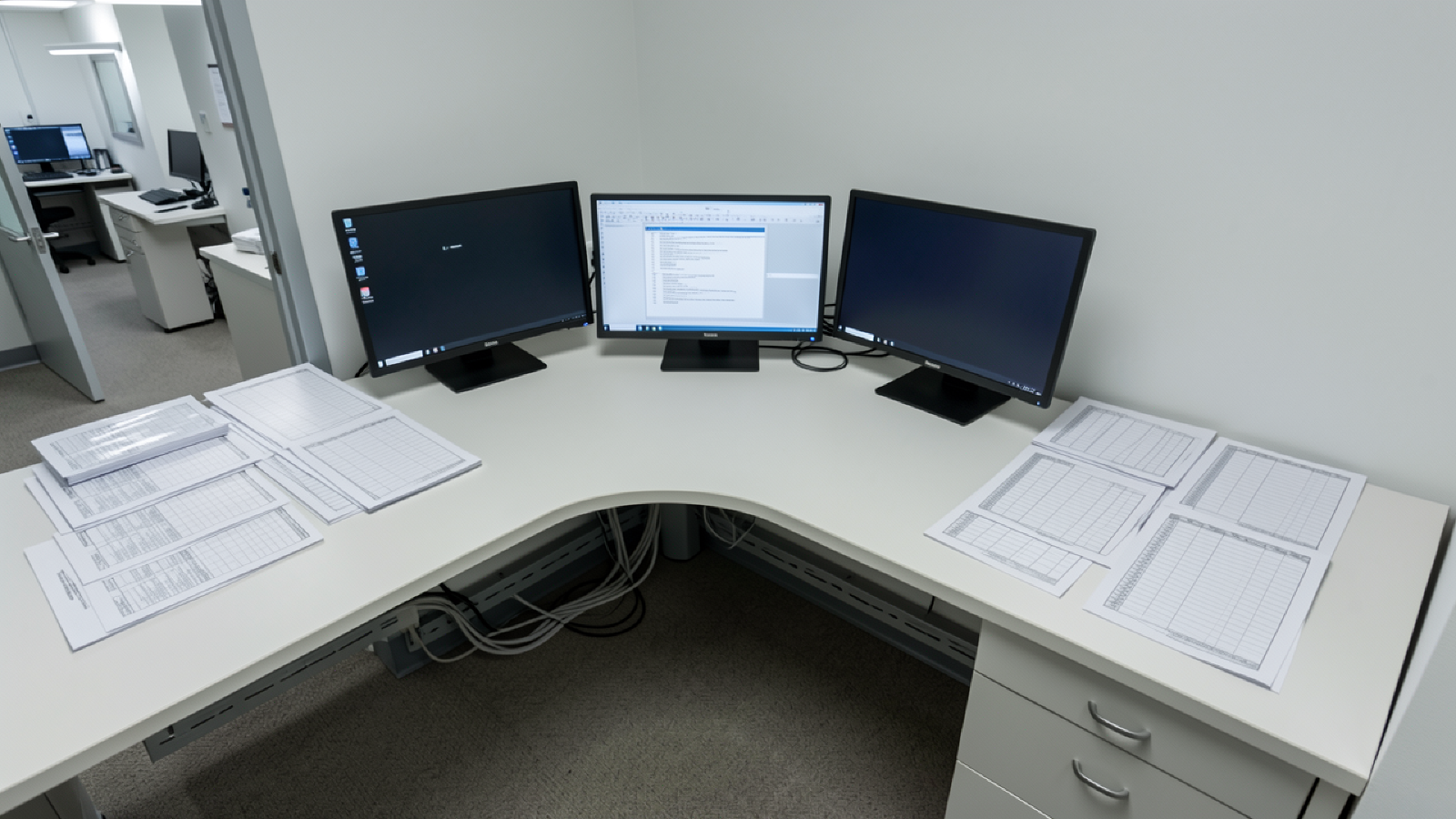
Danielle Okafor sees the denial hit the dashboard at 9:14 on a Tuesday morning. She is the operations analyst for a PE-owned imaging center in suburban Charlotte, and the denial is for an MRI of the lumbar spine, CPT 72148, billed to UnitedHealthcare. Clinical necessity denial. The patient was seen, the scan was performed, the radiologist read it, the report went to the referring physician. All of that happened. What did not happen was the correct documentation attachment. The prior authorization was approved, but the authorization letter referenced the ordering physician’s clinical notes from January. The scan was performed in March. UHC’s automated review flagged the date gap and denied.
In the current workflow, Danielle would open the denial, read the reason code, pull the chart, identify the documentation gap, contact the ordering physician’s office for updated notes, wait two to five days for a response, compile the appeal packet, submit it through UHC’s portal, and track the outcome. Elapsed time from denial to appeal submission: seven to fourteen days. That timeline is not Danielle’s fault. It is the shape of a process that requires a human to identify the problem, communicate across organizations, assemble documents, and submit through a payer portal designed to be slow.
The operational brain processes this differently. Five agents activate in sequence within four hours.
The revenue cycle concierge classifies the denial. Clinical necessity, documentation gap, prior authorization mismatch. The classification is not a label; it is a structured analysis that determines which agents activate next and in what order. The compliance concierge verifies the coding. CPT 72148 is correct for the procedure performed. ICD-10 diagnosis code matches medical necessity criteria for UHC’s published guidelines. The coding is clean; the denial is not a coding error. The prior authorization concierge checks the root cause. The authorization was approved under reference number UHC-2026-0847. The authorization letter references clinical notes dated January 12. The scan was performed March 8. The gap triggered the automated denial. Root cause identified: documentation attachment error at submission, not clinical necessity failure.
The payer contract concierge checks the appeal timeline. UHC’s contract with this imaging center specifies a 90-day appeal window from date of denial. The denial posted today. The appeal window closes in June. But the contract also specifies that appeals submitted within 30 days receive expedited review. The clock matters. The revenue cycle concierge generates the appeal. It attaches the correct clinical notes dated February 28 (the pre-procedure evaluation), the authorization approval letter, the radiology report, and a cover letter mapping each document to UHC’s denial reason code. The quality concierge records the pattern: documentation attachment error, third instance this quarter, all involving the same referring physician’s office.
Total elapsed time from denial to appeal submission: four hours. No phone calls to the referring physician’s office, because the correct clinical notes were already in the system; the original submission attached the wrong version. No manual document assembly, because the agents know which documents map to which denial reasons. No portal navigation delay, because the appeal submits electronically through the payer integration.
The Operational DAG#
The five-agent sequence is not hardcoded. It is a directed acyclic graph, a workflow structure where each node is an agent action and each edge is a dependency. The revenue cycle concierge must classify before the compliance concierge can verify coding, because the coding verification depends on the denial type. The compliance concierge must verify before the prior authorization concierge investigates, because a coding error would change the investigation path. The payer contract concierge can run in parallel with the prior authorization concierge, because the appeal timeline check does not depend on root cause identification. The final appeal generation depends on all four upstream nodes completing.
This is a DAG for one denial type at one entity type. A physician practice denial DAG looks different. The agents are similar, but the sequencing changes because physician practices handle denials through different workflows than imaging centers. A lab denial DAG is different again. CLIA compliance introduces a node that imaging centers do not have. An ASC denial for a surgical procedure introduces anesthesia coding verification that neither labs nor imaging centers need.
The DAGs are not designed by engineers and frozen. They are learned from workflow patterns and configurable per entity. When a new imaging center joins the portfolio, the operational brain starts with the default imaging center DAG. As the system processes denials at that specific center, it observes which sequences produce successful outcomes and which produce delays. A center whose payer contracts have unusually short appeal windows will see the payer contract node move earlier in the sequence. A center with a high rate of coding-related denials will see the compliance node weighted more heavily. The DAG adapts.
The adaptation has limits. The dependency structure, which nodes must complete before others can start, is architecturally enforced. The compliance concierge will never verify coding before the revenue cycle concierge classifies the denial, because the verification requires the classification as input. What adapts is the priority weighting, the parallel execution decisions, and the threshold at which the system escalates to human review rather than proceeding autonomously.
The H-Layer and O-Layer Split#
The consumer architecture described in BMT-02.01 separates a planning brain (the H-layer) from executing hands (the L-layer). One brain per person. Many hands shared across people. The brain decides what to do; the hands do it. The separation exists because a single brain must hold the full context of one person’s life, while the hands need only the context of one task.
The operational architecture inherits this separation but applies it to a fundamentally different problem. The consumer H-layer handles one person’s request at a time. Margaret asks about her medication, and the H-layer reasons about which agents to involve, in what order, with what context. The request is human-scale: one question, one person, seconds to respond.
The operational H-layer handles entity-level events that may involve dozens of concurrent workflows. An imaging center generates thirty to fifty operational events per day: denials, scheduling changes, equipment alerts, staffing gaps, quality metrics, payer communications. Each event triggers its own DAG. Each DAG may involve three to seven agents. The operational H-layer is not processing one request; it is managing a queue of concurrent workflows with dependency tracking, priority ordering, and resource allocation across shared agents.
The scale difference is not just quantitative. Margaret’s H-layer resolves ambiguity by asking her. The operational H-layer resolves ambiguity by consulting the entity’s operational configuration: what are the denial handling priorities, what is the scheduling fill policy, what is the staffing flexibility range. These are not personal preferences; they are organizational policies encoded as configuration. The operational H-layer holds the entity’s operational identity the same way the consumer H-layer holds the person’s personal context.
The O-layer executes each agent’s function within a DAG, passing outputs as inputs to downstream nodes. The separation matters for the same reason it matters in the consumer architecture: coherence requires a single point of coordination, while execution requires distributed speed. But the operational O-layer adds a capability the consumer O-layer does not need: cross-DAG awareness. When the scheduling concierge is processing a waitlist fill and the quality concierge is simultaneously processing a utilization review, the O-layer knows both are running and prevents conflicts. The consumer architecture rarely has two workflows competing for the same resource. The operational architecture has it constantly.
Cross-DAG awareness also prevents cascading actions that could compound. If the revenue cycle concierge is processing a batch of denials while the compliance concierge is simultaneously flagging a documentation pattern, the O-layer coordinates the two workflows so that the compliance findings inform the denial responses rather than running in parallel and producing contradictory outputs. The orchestration is not just about speed; it is about coherence across concurrent operational processes.
Latency and Throughput#
The consumer architecture operates on a human conversational timescale. Margaret asks a question and expects a response within two seconds. The latency budget is tight and perceptually bounded. A three-second response feels slow. A five-second response feels broken.
Operational workflows operate on a different timescale entirely. The denied claim DAG completes in four hours and that is fast. A payer contract analysis DAG may run for days, accumulating data from multiple sources, correlating patterns across billing periods, and producing a recommendation that the operating partner reviews next week. A credentialing workflow for a new physician spans weeks, with external verification steps that the system cannot accelerate.
The operational brain manages these different timescales simultaneously. The priority queue ranks active workflows by urgency, financial impact, and deadline proximity. A denial with a 30-day expedited review window ranks higher than a credentialing application with a 90-day timeline. A scheduling gap for tomorrow’s MRI slots ranks higher than a quarterly quality report due in six weeks.
A portfolio of eighty entities may generate hundreds of operational events per day, each triggering its own DAG. The operational brain does not process them sequentially. It runs concurrent DAGs with shared agent resources, managing contention the same way an operating system manages process scheduling. The scheduling concierge at Entity A and the scheduling concierge at Entity B are the same agent with different context packages. The agent is shared; the context is isolated. This is the same principle the consumer architecture uses for L-layer skills, applied at entity scale.
The throughput challenge is not raw computation. It is context management. Each active DAG carries state: which nodes have completed, what outputs they produced, which nodes are blocked, what the current priority score is. The operational brain maintains this state for every active workflow across every entity in the portfolio. A portfolio of eighty entities with an average of forty active workflows per entity means the operational brain is tracking roughly 3,200 concurrent workflow states. The state is lightweight per workflow, but the aggregate demands careful memory management and garbage collection as workflows complete.
Error Handling and Recovery#
The DAG breaks. The compliance concierge cannot verify coding because the EHR integration is returning errors. The prior authorization concierge cannot check the authorization status because the payer portal is down. The quality concierge cannot record the pattern because the data warehouse is undergoing maintenance.
The operational brain handles partial execution because operational workflows cannot pause and wait for a human to notice the problem. The system completes available steps, queues blocked steps with their dependency state preserved, notifies responsible parties through the appropriate channel, and resumes automatically when the blockage clears.
The notification is not a generic alert. The system knows who cares about which blockage. An EHR integration failure at the Charlotte imaging center notifies Danielle and the IT coordinator, not the operating partner managing the full portfolio. A payer portal outage affecting twelve entities across the portfolio notifies the operating partner, because the scope is portfolio-level. The escalation follows the three-tier hierarchy described in BOI-02.04: entity-level problems go to entity-level humans; portfolio-level problems go to portfolio-level humans.
Recovery is not just resumption. When a blocked step completes after a delay, the operational brain reassesses the downstream DAG. If the denial appeal was blocked for 48 hours because the payer portal was down, the appeal timeline may have shifted from expedited to standard. The payer contract concierge re-evaluates the timeline. If the expedited window has closed, the appeal priority adjusts. The system does not blindly resume where it stopped; it re-evaluates the current state before proceeding.
The Learning Loop#
The operational brain improves its DAGs through outcome analysis, not through manual process reengineering. Every completed workflow generates an outcome signal. The denial appeal succeeded or failed. The scheduling optimization increased or decreased utilization. The credentialing application was approved in 45 days or 90 days.
These outcomes feed back into DAG optimization. If denial appeals submitted within 24 hours have a 15% higher success rate than appeals submitted on day seven, the brain learns to prioritize denial processing. The learning is not abstract; it manifests as concrete changes to the priority queue weights. If appeals with the correct clinical notes attached at first submission have a 92% success rate while appeals requiring supplementary documentation have a 71% success rate, the brain learns to verify documentation completeness before submission rather than after rejection.
The learning loop operates within guardrails. Optimization targets are configurable per entity. An entity that prioritizes cash flow will weight financial impact more heavily in its priority queue. An entity that prioritizes quality scores will weight compliance workflows more heavily. The brain does not impose a single optimization function across the portfolio; it learns each entity’s operational priorities and adapts its DAG execution accordingly.
The learning also crosses workflow types. The operational brain notices relationships between workflow categories that no individual agent would detect. If scheduling cancellations spike on Mondays after holiday weekends, and those cancellations correlate with a 20% increase in denial processing workload on Tuesday (because the Monday cancellations lead to rescheduling, which leads to authorization timing gaps, which leads to denials), the brain learns to pre-position denial processing capacity for Tuesday after holiday weekends. No single agent sees both the scheduling pattern and the denial pattern. The brain sees the correlation because it orchestrates both workflows.
The learning also has boundaries. It does not modify the dependency structure of DAGs, because those dependencies reflect architectural requirements, not optimization targets. It does not override escalation thresholds, because those reflect governance decisions. It does not extrapolate from one entity’s outcomes to change another entity’s DAG configuration, because each entity’s operational environment is different enough that cross-entity extrapolation without validation could degrade performance rather than improve it. Cross-entity learning happens through the pattern propagation architecture in BOI-02.02, not through direct DAG modification. It optimizes within the operational envelope that the entity and portfolio governance have defined, and it gets better at that optimization with every workflow it completes.
This is the operational brain: a DAG-based orchestration engine that coordinates eighteen agents across concurrent workflows, adapts its sequencing through outcome-driven learning, handles failures through partial execution and intelligent recovery, and scales from a single entity’s daily operations to a portfolio’s hundreds of daily events. The consumer brain reasons about one person. The operational brain reasons about an organization. The architecture is the same. The complexity is not.
Cross-References
BMT-02.01 The Brain and the Hands: the consumer H-layer/O-layer architecture that the operational brain inherits and extends for entity-level orchestration.
BMT-02.04 How a Request Becomes an Action: the consumer workflow model from request to execution, paralleled here by the operational DAG from event to resolution.
BOI-01.01 The Operational Eighteen: the full roster of operational concierge agents that the brain orchestrates across concurrent workflows.
BOI-02.02 Cross-Entity Orchestration: how the single-entity DAGs described here extend to multi-entity pattern detection and portfolio-level intelligence.
BOI-02.04 When the System Escalates: the three-tier escalation hierarchy that governs when DAG execution pauses for human decision-making.
Technical Appendix BOI-02.01-A is available to partners and investors at partners.bluemirror.tech.