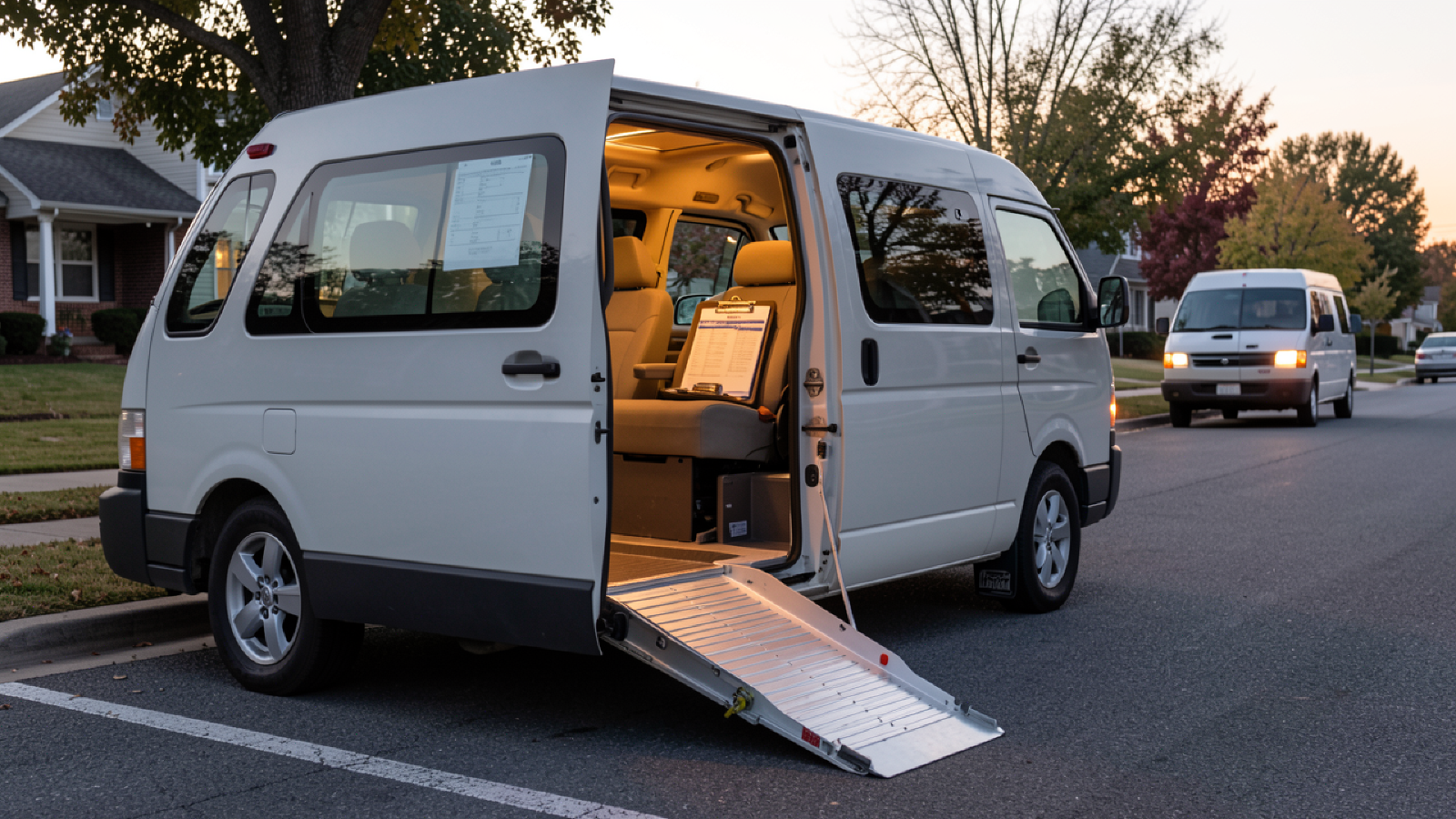
Diane pulls up the Tuesday dispatch screen at 6:14 AM and counts thirty-seven trips across three counties. Twelve require wheelchair-accessible vehicles. Four involve dialysis patients with strict appointment windows. One passenger needs a gurney transport for a wound care visit forty minutes away, and the Medicaid broker authorization came through at 11 PM last night with the wrong pickup address. By 6:22 AM she has already called two drivers to swap assignments, because the van with the functional ramp is in the shop and the backup van is forty minutes from the first pickup.
This is non-emergency medical transportation before operational intelligence. Diane is good at her job. She has been dispatching for nine years, knows her drivers by name, and can route a three-county morning in her head faster than most software can render it on screen. But the PE firm that acquired her company six months ago also acquired two other NEMT operators in adjacent markets, and now Diane coordinates with dispatchers she has never met, serving areas she has never driven, under Medicaid billing rules she has never read. The spreadsheet she kept for tracking driver certifications covered fourteen drivers. The portfolio has ninety-three. Her mental model of which vans can handle which passengers worked when she knew every vehicle. Now there are sixty-one vehicles across three garages, and the maintenance records live in three different systems.
The NEMT vertical activates more operational concierge agents simultaneously than any other service vertical. Routing and logistics (BOI-01.07), scheduling (BOI-01.06), benefits and eligibility (BOI-01.05), credentialing (BOI-01.11), compliance (BOI-01.14), and fleet management (BOI-01.10) all engage on every trip. And unlike clinical verticals where the consumer connection passes through a physician, NEMT connects directly to the person being served. Every trip physically links an aging adult to a healthcare service. The connection is not metaphorical. The vehicle arrives at the person’s home, the driver assists with boarding, the trip delivers the person to a clinical appointment, and the return trip brings them home. No intermediary, no referral, no appointment scheduler standing between the service and the person.
On the consumer side, Margaret’s health concierge scheduled her Tuesday cardiology appointment three weeks ago. The concierge determined she needs wheelchair-accessible transport, accounted for her boarding pace (slower in the morning, improving after her arthritis medication takes effect around 10 AM), and built a ninety-minute pickup buffer for mobility constraints and traffic. On the operational side, the routing concierge received the trip request through the membrane with exactly what it needed: pickup time, destination, accessibility requirements, return trip timing, and the fact that Margaret prefers a familiar driver when available. The routing concierge assigned a wheelchair van already running two nearby pickups, verified her Medicaid coverage for the destination (cardiology is a covered service in her state), and pre-generated the trip documentation that will satisfy the broker’s verification requirements.
Margaret does not know any of this happened. She knows her ride arrives at 9:15 AM. Diane, in the old model, would have assembled all of this manually from three phone calls, a fax from the broker, and Margaret’s intake form from eight months ago. The intake form listed Margaret’s accessibility needs as “wheelchair,” which tells Diane the vehicle type but nothing about boarding pace, morning stiffness, driver preference, or the anxiety Margaret experiences when an unfamiliar driver arrives. Context that makes the difference between adequate transport and good transport.
The route optimization challenge in NEMT extends well beyond point-to-point navigation. Multi-stop routing with variable passenger needs, each with different accessibility requirements and different appointment windows, creates a constraint satisfaction problem that compounds across a fleet. Pickup windows are not symmetric: a passenger arriving thirty minutes early sits in a waiting room, which is acceptable. A passenger arriving ten minutes late misses a dialysis chair slot, which triggers a cascade of rescheduling across the dialysis center’s entire day. Return trip coordination introduces genuine uncertainty, because an appointment scheduled for forty-five minutes may take ninety, and the vehicle assigned for pickup cannot wait indefinitely when three other passengers need transport.
The routing concierge addresses this through real-time disruption handling that Diane’s dispatch board cannot replicate at scale. When Margaret’s cardiology appointment runs twenty minutes long, the health concierge signals the delay through the membrane. The routing concierge reassigns Margaret’s return pickup to a vehicle completing a nearby drop-off rather than holding her original vehicle. The two passengers on that original vehicle’s route are picked up on time. Margaret waits four minutes instead of twenty-five. No driver makes a frantic phone call. No passenger sits wondering whether their ride forgot them.
At portfolio level, the routing concierge identifies patterns invisible to any single operator. Route density analysis across three acquired companies reveals that Company A and Company B both run partially filled vehicles through the same corridor every Tuesday and Thursday morning. Consolidating those routes into shared corridor service improves vehicle usage from 62% to 81% without adding a single vehicle. Fleet usage benchmarking across the portfolio surfaces a different problem: Company C’s wheelchair van fleet runs at 91% capacity on weekdays, meaning one breakdown or one sick driver creates service gaps that cascade through the day. The procurement concierge flags this as a fleet sizing issue before the gap materializes. Service gap identification maps geographic areas where the portfolio has subscribers but no routes, revealing acquisition targets or partnership opportunities that the PE operating partner would otherwise discover through patient complaints.
The benefits eligibility challenge for NEMT is among the most complex in healthcare services. In one state, all Medicaid beneficiaries qualify for NEMT with twenty-four-hour advance notice. In the next state, NEMT covers only transport to Medicaid-covered services, requires broker authorization for each trip, and limits total monthly trips. In a third, the state contracts with a managed transportation benefit administrator that maintains its own provider network and credentialing standards. Medicare Advantage supplemental benefits add another layer entirely: each plan defines its own transportation benefit, some covering a fixed number of trips per year, others requiring pre-authorization per trip, others bundling transport with other supplemental benefits in ways that affect eligibility determination.
The benefits and eligibility concierge navigates this per trip, per passenger, per state. For Margaret’s Tuesday cardiology trip, the concierge verified that cardiology is a covered service under her state’s Medicaid NEMT benefit, confirmed that her MA plan does not override Medicaid as the transportation payer (coordination of benefits for dual-eligible passengers is a billing error source that compounds across hundreds of trips), and pre-generated the trip verification documentation in the format the state’s broker requires. When Margaret’s daughter schedules a Saturday pharmacy run, the benefits concierge determines that this trip does not qualify under Medicaid NEMT (pharmacy is not a covered service destination in this state) but does qualify under Margaret’s MA supplemental benefit, routes the billing accordingly, and documents the payer pathway for audit. Across the portfolio, the benefits concierge processes these determinations for every trip, every passenger, every day. A single billing error on a Medicaid NEMT trip can invalidate the entire billing period for that passenger if the state audits and finds the service destination was not covered. The concierge prevents the error before the trip runs.
Driver credentialing in NEMT carries a heightened trust dimension. These drivers enter the personal space of vulnerable adults, assist with boarding and mobility devices, and spend thirty to sixty minutes in close proximity during transport. License verification, background checks, drug testing, CPR and first aid certification, defensive driving, ADA sensitivity training, and vehicle-specific certification (wheelchair securement, gurney operation) form the baseline. States layer additional requirements: some mandate a state-specific NEMT driver certification, others require annual refresher training, others impose mileage-based recertification intervals. The credentialing concierge tracks each driver against each state’s requirements across the portfolio. When the PE firm acquires an operator in a new state, the credentialing concierge maps that state’s driver requirements against the existing driver pool and identifies gaps before the first trip runs. A driver certified in State A who picks up a cross-border trip into State B may not meet State B’s requirements. The concierge catches this at assignment, not at audit.
Fleet and vehicle management connects to the procurement and facility maintenance concierges. ADA equipment inspection schedules, wheelchair lift testing and documentation, vehicle registration and insurance tracking across states, and preventive maintenance scheduling all feed into the compliance concierge’s audit readiness tracking. The procurement concierge handles fleet decisions that span the portfolio: replacement cycle optimization (the twelve-year-old van with $14,000 in annual maintenance versus a lease on a new vehicle), EV transition modeling for urban corridors where range supports it, and fleet right-sizing based on actual usage data rather than dispatcher intuition. Diane knew that Van 7 was unreliable. The procurement concierge knows that Van 7 has had eleven unscheduled maintenance events in fourteen months, that its per-mile operating cost is 2.3 times the fleet average, and that replacing it with a leased vehicle recovers the cost difference in nine months.
The consumer connection in NEMT runs deeper than any other service vertical. The health concierge knows Margaret’s appointment schedule, her mobility profile, her anxiety about unfamiliar drivers, and that she becomes fatigued in the afternoon. The NEMT system knows routes, vehicles, driver availability, and real-time traffic conditions. Through the membrane, these two intelligence layers compose a transport experience that neither could produce alone: a familiar driver whenever scheduling permits, a route that avoids the construction zone Margaret finds stressful, boarding-pace-adjusted timing that accounts for her slower mornings, and a return trip coordinated not with the scheduled appointment end time but with the actual appointment completion signal from the health concierge.
No standalone NEMT optimizer accesses consumer mobility data. No consumer platform accesses fleet routing intelligence. The membrane makes both directions possible while ensuring that the NEMT company sees only what it needs (accessibility requirements, timing, pickup location) and the consumer platform sees only what it needs (estimated arrival, driver identity, vehicle type). The closed loop produces a transport experience that a dispatch screen and a phone call cannot replicate.
The honest constraint: NEMT operational intelligence depends on the consumer platform’s deployment density in a given service area. In a market where BlueMirror serves 200 subscribers and the NEMT company transports 3,000 passengers daily, the membrane-enabled transport represents a small fraction of trips. The consumer connection is real but limited in impact until subscriber density reaches a threshold where membrane-enabled trips constitute a meaningful share of the NEMT company’s volume. That threshold varies by market size, passenger demographics, and the NEMT company’s service area overlap with BlueMirror’s subscriber geography. The operational value of the concierge architecture (routing, credentialing, compliance, fleet management) stands independent of consumer platform density. Diane’s dispatch gets better on day one. The membrane connection gets better over time.
Cross-References#
The Benefits and Eligibility Concierge (BOI-01.05). NEMT eligibility determination is among the most complex deployments of this agent, with state-specific rules, payer coordination, and per-trip verification requirements.
The Routing and Logistics Concierge (BOI-01.07). The NEMT vertical is the primary deployment context for this agent, with multi-stop, multi-vehicle, accessibility-constrained routing at portfolio scale.
The Credentialing Concierge (BOI-01.11). Driver credentialing across states with different requirements, compounded by PE portfolio expansion into new markets.
The Health Concierge (BMT-01.02). The consumer side of the NEMT connection: appointment scheduling, mobility assessment, and transport coordination through the membrane.
The Physician Practice Portfolio (BOI-03.01). The destination entity that the NEMT company serves, where scheduling coordination between transport and clinical appointment creates the tightest operational coupling.
Technical Appendix BOI-04.01-A is available to partners and investors at partners.bluemirror.tech.